ATLAS IMAGISTICA
Centre of Excellence in Medical Imaging | Targu-Mures, Romania
Intelligent case allocation in teleradiology: how subspecialisation protects both the patient and efficiency
Why the right case, reaching the right radiologist, is at the same time a clinical decision and an operational advantage for clinics and hospitals
How cases are distributed in radiology: the “first available radiologist” queue versus allocation by subspecialty
The classic model for distributing cases within a radiology or teleradiology service is often a simple queue: the study arrives, and the first available radiologist opens it. The model has one advantage - simplicity - and a hidden cost: a complex brain MRI study may reach a radiologist specialised in musculoskeletal imaging, and a thoracic CT angiography may reach someone without vascular subspecialisation. Both are competent radiologists; neither has, at that moment, the optimal match for the case.
Intelligent case allocation is the mechanism that solves precisely this mismatch: each study reaches the radiologist whose competencies, availability and history with that particular patient are the best fit for the case. The difference is not only clinical. It is also operational - and the specialist literature quantifies both effects.
The right case with the right radiologist is not a detail of internal organisation. It is, simultaneously, a parameter of patient safety and a parameter of operational efficiency.
What the specialist literature shows: the difference between a general radiology report and a subspecialty one
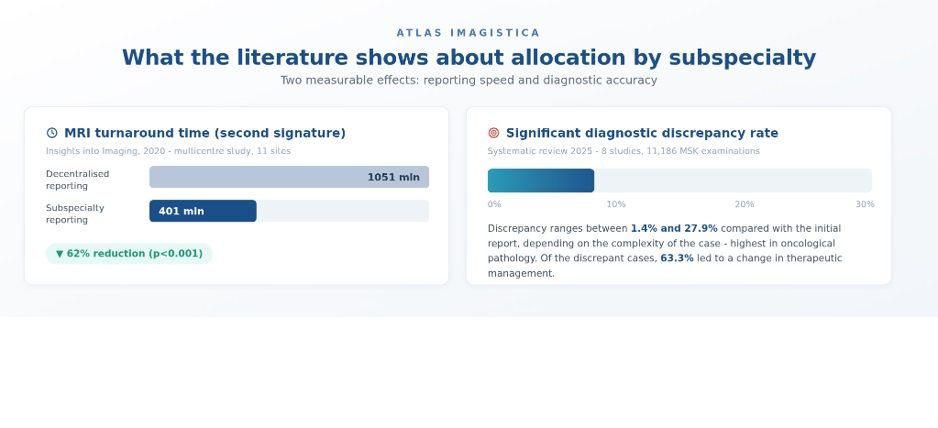
A systematic review published in 2025, which brought together 8 studies and 11,186 examinations reinterpreted by musculoskeletal subspecialist radiologists, documented clinically significant discrepancy rates of between 1.4% and 27.9% compared with the initial report - with the highest rates (17.5%-27.9%) in oncological cases, where the complexity of interpretation is greater, and the lowest (1.4%-5.8%) in knee MRI and appendicular radiographs. In one of the included studies, of the cases with a discrepancy, 63.3% actually led to a change in therapeutic management - from biopsy recommendations becoming imaging follow-up, to surgical indications becoming conservative treatment.
The practical conclusion: the more complex the pathology, or the more specific it is to a subspecialty, the more clinically relevant the difference between a general radiologist and a subspecialist becomes - not merely theoretically.
The less visible effect: reporting turnaround time
A multicentre study published in Insights into Imaging (2020), conducted across 11 sites of a radiology network, compared the report turnaround time (RTAT) before and after the shift from a decentralised reporting model to one organised by subspecialty. The results were consistent and statistically significant (p<0.001): for MRI, the turnaround time to second signature (final validation) fell from 1,051 to 401 minutes - a reduction of approximately 62%. Conventional radiographs likewise recorded a decrease from 278 to 171 minutes, and the smaller hospitals in the network benefited most visibly from this change.
Allocation by subspecialty does not slow the workflow, as one might intuitively assume - on the contrary, it eliminates the time lost on reallocations, additional queries and cases “set aside” for a more suitable colleague.
How intelligent case allocation works at Atlas Imagistica
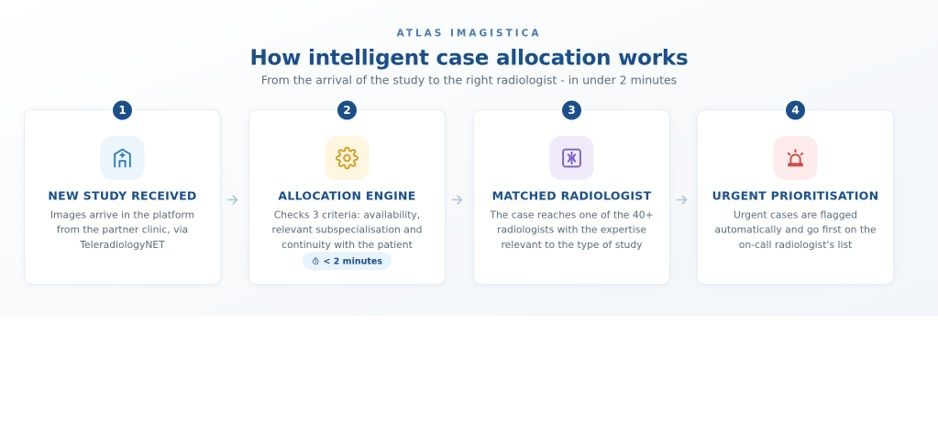
When a study arrives in the platform, our automatic allocation system identifies and assigns the case to the appropriate radiologist in under two minutes, based on three criteria: availability (who is active on shift), the subspecialisation relevant to the type of study (cardiac, vascular, ENT, musculoskeletal, neuroradiology, oncological, gastrointestinal) and continuity - whether the radiologist has previously interpreted studies of the same patient. Urgent cases receive a distinct marking and are automatically highlighted at the top of the list of the radiologist on active duty.
The Atlas Imagistica medical team brings together more than 40 radiologists covering the entire spectrum of diagnostic imaging, which makes a genuine match between the type of case and the available expertise in teleradiology possible - not only on paper, but in the daily workflow.
What allocation by subspecialty means for the radiologist and for the hospital manager
For the radiologist
For the administrator / hospital manager
Receives cases matched to their own subspecialisation, not an undifferentiated flow
Genuine competitive differentiation from providers that allocate on a “first available” basis
Reports with greater accuracy on complex pathology, with a reduced risk of major discrepancy
Lower rate of re-readings, challenges and corrections - less administrative time lost
Continuity on the same patient across follow-up studies - complete clinical context
Increased satisfaction of the partner clinic, which sees consistency in interpretation
Urgent cases are flagged automatically and come first on the list, rather than being lost in the volume
More predictable turnaround time for emergencies - a concrete argument in SLA negotiations
Greater professional satisfaction: expertise is used, not diluted
Better radiologist retention - recruitment cost avoided
What a partner clinic or hospital should ask about case allocation
For administrators evaluating or re-evaluating a teleradiology provider, a few questions separate a genuine allocation system from a marketing promise:
- Is allocation performed automatically, on documented criteria, or manually, “as the turn comes”?
- How much time passes, on average, from receipt of the study to its assignment to a radiologist?
- Is there guaranteed continuity for patients with follow-up studies, or is each examination treated in isolation?
- How are urgent cases identified and prioritised within the workflow?
- What proportion of active radiologists have a declared, verifiable subspecialisation?
Conclusion: case allocation is an organisational decision that shows in the results
At first glance, case allocation appears to be an administrative detail - a back-office function with no clinical visibility. The data show the opposite: it directly influences the diagnostic discrepancy rate, the turnaround time and, ultimately, both patient safety and the operational efficiency of the imaging service.
At Atlas Imagistica, intelligent allocation is not an optional module of the platform, but the foundation on which every other quality promise is built - for the radiologists who interpret the studies and for the partners who rely on their results.
Discuss with the Atlas Imagistica team how case allocation works in your current practice
[email protected] | +40 770 341 500 | atlasimagistica.com
About Atlas Imagistica
Atlas Imagistica is a Centre of Excellence in Medical Imaging based in Targu-Mures, Romania, founded and led by Dr. Sorin Rosca MD. We provide AI-assisted teleradiology services to hospitals and clinics in Romania 24 hours a day, 365 days a year.
[email protected] | +40 770 341 500 | atlasimagistica.com