How much does the lack of round-the-clock radiology coverage really cost
Four hidden costs that no hospital usually puts in the same equation
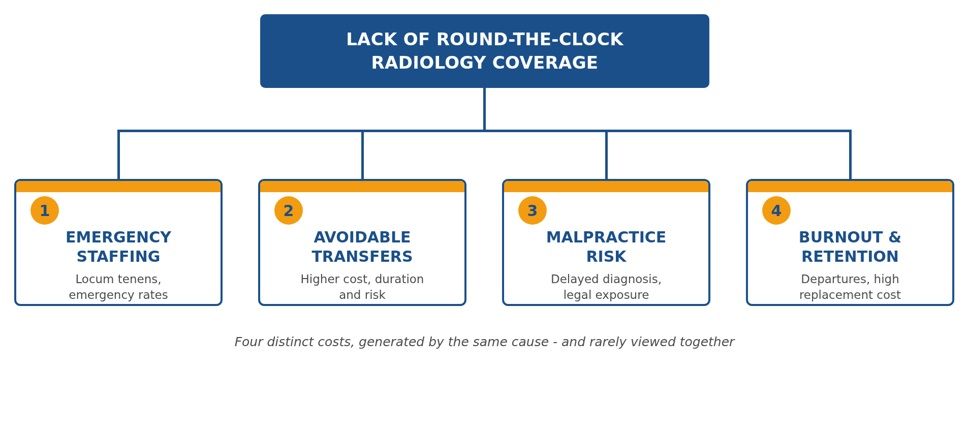
Four categories of costs that many hospitals analyse separately, even though they stem from the same problem
For most hospital managers, the cost of lacking radiology coverage during the night or at weekends comes down, first and foremost, to staffing expenses: an additional on-call shift, a locum physician or a higher rate to cover a difficult shift. These are real and easily identifiable costs, because they appear directly in the budget.
In reality, however, these represent only part of the financial impact generated by the lack of continuous radiology coverage.
When a hospital cannot ensure the interpretation of imaging examinations 24 hours a day, the consequences extend beyond salary costs. Transfers that could have been avoided occur, exposure to malpractice litigation increases, and the additional pressure on the existing team encourages professional burnout and the departure of physicians. Each of these effects is tracked by a different department, appears in a different report and is assessed separately. This is precisely why they are rarely viewed together, as manifestations of the same problem.
Our experience, accumulated through collaboration with hospitals across the country, shows that decisions regarding radiology coverage are most often evaluated starting from the immediate cost of an on-call shift. Indirect costs, although often far more significant, remain in the background.
This is why we have prepared this material. Not to demonstrate that a particular solution is cheaper, but to show the overall picture and to highlight all the cost categories generated by the lack of continuous radiology coverage.
The problem is not how much an uncovered shift costs. The right question is how much, overall, the lack of a sustainable radiology coverage solution ends up costing.
The four categories of costs generated by the lack of radiology coverage
COST 1
Staffing costs
- When night, weekend or holiday on-call shifts cannot be covered with existing staff, hospitals are forced to find solutions within a very short time.
- Most often, this means ad-hoc collaborations with locum physicians or other forms of emergency coverage, which involve considerably higher rates than those negotiated within a partnership planned over the long term.
COST 2
Transfers that could have been avoided
- In the absence of a radiologist available to interpret an examination, patients are sometimes transferred to other medical facilities, even though the imaging examination could have been performed at the hospital of origin. These transfers generate additional costs, prolong the length of hospitalisation and can delay the establishment of the diagnosis and the initiation of treatment.
COST 3
Medico-legal risk
- The interpretation of examinations outside regular hours, under time pressure or outside the physician's area of subspecialisation, increases the risk of diagnostic errors. When these occur, the consequences are not only clinical, but also legal and financial, both for the hospital and for the medical team.
COST 4
Burnout and staff turnover
- In many hospitals, the lack of a permanent solution is compensated by overloading the existing radiologists. Repeated on-call shifts, extended hours and a high volume of work encourage professional burnout, reduce job satisfaction and increase the likelihood that physicians will leave the organisation. The cost of replacing a specialist is often far higher than the cost of preventing this situation.
Cost 1: Covering on-call shifts on an emergency basis
When a hospital cannot ensure radiology coverage for nights, weekends or public holidays, the available solutions are, as a rule, reactive. A radiologist is sought within a very short timeframe, an on-call shift is negotiated on an ad-hoc basis, or external collaborators who can step in immediately are called upon.
These situations are inevitably more expensive than a planned solution. Not because the medical act is different, but because immediate availability has a price. The more urgent the need, the higher the associated costs, and the less negotiating power the hospital has.
International data confirm this trend. According to AMN Healthcare, one of the largest American providers of temporary medical staff, rates for locum tenens radiologists in general diagnostic radiology average around 290-370 USD per hour, and can exceed 450-520 USD per hour for subspecialty work or for hard-to-cover night shifts, to which transport, accommodation and credentialing costs are added. Although the Romanian market operates according to different mechanisms and at different cost levels, the economic principle is the same: coverage arranged at the last moment is almost always more expensive than one planned and contracted in advance.
This pressure on costs is amplified by a phenomenon affecting the whole of Europe: the shortage of radiologists.
According to the EU-REST study (“Current status of radiologist staffing, education and training in the 27 EU Member States”), published in 2025 in Insights into Imaging, the journal of the European Society of Radiology, 45% of European radiologists were over 51 years of age in 2022, and approximately 19% were due to retire within the following five years. At industry level, other estimates indicate an increase in the need for imaging examinations of approximately 70% by 2030 - at a pace that far exceeds the annual growth in the number of radiologists, estimated at approximately 1%.
Romania trains a significant number of radiology specialists each year, but some of them choose to continue their careers in other European medical systems. For hospitals, the effect is the same: finding a radiologist available for an on-call shift is not becoming easier, but increasingly difficult.
From this perspective, the failure to cover a shift is not merely a problem of internal organisation. It reflects a structural pressure on the entire medical system and explains why improvised solutions tend to become ever more costly.
Cost 2: Transfers that could have been avoided
When the imaging examination can be performed but there is no radiologist available to interpret it, transferring the patient to another hospital sometimes becomes the only option.
At first glance, the decision appears strictly medical. In reality, in many situations it is determined by the lack of availability of the interpretation service, not by technological limitations or the complexity of the case.
Numerous studies have shown that a significant proportion of interhospital transfers for acute surgical emergencies could be avoided if the imaging diagnosis could be established at the facility where the patient initially presented. An American study published in 2021 (Scott et al., conducted on over 500,000 episodes of emergency general surgery across 8 American states) found that 27.4% of interhospital transfers were potentially avoidable - cases in which the patient was discharged less than 72 hours after transfer, without any procedure or intervention at the receiving hospital.
The consequences go beyond the cost of transport.
Compared with patients treated at the hospital where they were initially examined, transferred patients have, on average, a longer hospital stay, a higher complication rate and higher direct costs for the medical system. When the transfer is carried out by air, costs can become several times higher than in the case of ground transport.
Of course, there are numerous situations in which the transfer is fully justified. Cases requiring locally unavailable equipment, complex interventions or ultra-specialised expertise must be directed to centres with a higher level of competence.
There is, however, also a different category of transfers: those generated solely by the impossibility of interpreting an examination that has already been performed.
In these situations, the problem is not the absence of a CT scanner or an MRI machine, nor the technical inability to perform the examination. The examination already exists. Only its interpretation is missing.
When this can be carried out rapidly, including through a permanently available teleradiology service, the patient can remain at the hospital where they presented, and the therapeutic decision can be taken without unnecessary delays. The benefits are evident both for the patient and for the medical facility: reduced costs, the avoidance of non-essential transfers and more efficient use of available resources.
Cost 3: Exposure to medico-legal risk
Unlike staffing costs or those generated by interhospital transfers, medico-legal risk does not appear immediately in a hospital's budget. It materialises only when a diagnostic error leads to litigation, which is why it is often underestimated in assessing the real cost of the lack of radiology coverage.
The specialist literature consistently shows that missed, delayed or incorrect diagnosis represents the principal cause of malpractice litigation in radiology, being cited in over three-quarters of cases.
Some American analyses of malpractice litigation in radiology estimate an average award in the order of 452,000 dollars, above the average reported for medical specialties as a whole - a figure that nevertheless varies considerably from one study to another. In cases involving delays in the diagnosis of severe pathologies, such as certain forms of cancer, awards can exceed one million dollars.
These figures do not suggest that radiology is a less safe specialty than others. They reflect the consequences that a diagnostic delay can have in a discipline in which the imaging examination directly influences therapeutic decisions.
It is important to emphasise that the risk is not determined exclusively by the individual competence of the physician. The context in which interpretation takes place plays an equally important role.
A radiologist who, after a full working day, must interpret complex examinations during the night, possibly outside their own subspecialisation, works under different conditions compared with a physician who analyses the same type of examination during regular hours or within a service organised specifically for on-call activity.
Numerous studies have demonstrated that fatigue, high workload and frequent interruptions affect cognitive performance and increase the probability of interpretation errors. For this reason, reducing medico-legal risk does not only mean recruiting well-trained physicians, but also organising activity so that each examination is interpreted under conditions that favour diagnostic accuracy.
In this context, ensuring permanent access to radiologists with experience in the relevant subspecialty represents not only a measure of operational efficiency, but also a means of mitigating a risk that can have significant clinical, legal and financial consequences.
Cost 4: Professional burnout and the loss of radiologists
Of all the effects of the lack of continuous radiology coverage, this is probably the most difficult to quantify and, at the same time, one of the most costly in the long term.
In many hospitals, periods without coverage are compensated through the additional effort of existing radiologists. Repeated on-call shifts, extended hours and constant demand accumulate over time, and overwork gradually becomes part of routine activity.
The consequences are well documented.
Internationally, approximately 4 out of 10 physicians show signs of professional burnout - 41.9% in 2025, down from 43.2% in 2024 and 48.2% in 2023, according to the American Medical Association - and a significant proportion state their intention to change workplace in the coming years. Beyond the impact on staff wellbeing, these trends have direct implications for the functioning of hospitals.
The departure of a radiologist means far more than filling a vacant post. The process involves recruitment, onboarding, the temporary redistribution of activity to the other members of the team and a period in which the new physician is not yet functioning at full capacity.
According to the American Medical Association, replacing a single physician can generate costs ranging between 500,000 and over 1,000,000 dollars - recruitment, signing bonuses, revenue lost during the period the post is vacant and reduced productivity during the new physician's adjustment period - or, according to other economic models, the equivalent of two to three full annual salaries.
From a managerial perspective, this is one of the most difficult cost categories, because it produces a domino effect.
As the team shrinks, the workload of the remaining radiologists increases. The additional pressure encourages the onset of professional burnout, and the risk of further departures grows ever greater. In the absence of measures to reduce this pressure, the organisation can enter a vicious circle from which it becomes increasingly difficult to escape.
For this reason, planning radiology coverage should not be viewed exclusively as a problem of scheduling on-call shifts. It also represents an investment in staff retention, in the continuity of activity and in the hospital's capacity to keep its specialists in the long term.
Key points
(figures from international sources, predominantly the USA)
- approximately 64% of radiologists in the USA report having been involved, at some point, in a malpractice lawsuit (Medscape, 2021 - the most recent survey available; earlier surveys, from 2019, reported higher percentages, up to 71-76%)
- ~452,000 USD - the average award in a radiology malpractice lawsuit (USA; a figure that varies considerably between studies)
- 500,000 - over 1,000,000 USD - the estimated cost of replacing a physician (American Medical Association)
- 41.9% - the rate of professional burnout among physicians (2025, down from 48.2% in 2023) - American Medical Association
A note about the figures
The figures used above come from international studies on medical staffing, health economics and malpractice litigation - the most robust public data available for each type of cost. For the Romanian market there are, as yet, no public data at the same level of detail, and the exact amounts will not match identically the budget of any hospital in Romania. The role of these figures is not to give an exact total, but a framework for thinking. We recommend that any hospital director with whom we speak repeats this exercise using their own data: staffing contracts, the transfer log, litigation history and staff turnover. Even if the amounts differ, the four cost categories remain the same.
What changes when radiology coverage is ensured continuously
Analysed separately, the four cost categories appear to belong to different problems: staffing expenses, interhospital transfers, medico-legal risk and radiologist turnover.
In reality, they all have the same cause: the impossibility of consistently ensuring the interpretation of imaging examinations when it is needed.
From this perspective, the question is not whether a hospital can afford to ensure permanent radiology coverage, but how much it costs not to do so.
An organised solution for the interpretation of examinations, available 24 hours a day, does not completely eliminate these risks. Medicine will always involve complex situations, and no organisational model can guarantee the absence of errors or unforeseen costs.
It can, however, significantly reduce their frequency and impact.
Permanent radiology coverage means that examinations are interpreted without delays caused by the unavailability of a physician, that transfers are reserved for cases that genuinely need a higher level of competence, and that the internal team is not forced to permanently compensate for the lack of resources through overtime and repeated on-call shifts.
At the same time, access to radiologists with experience in different subspecialties contributes to standardising the quality of the medical act, regardless of when the patient arrives at the hospital.
There is also a quality dimension here, not only one of availability. When an examination is interpreted by a physician who is available and focused, rather than at the end of an exhausting shift and outside their area of competence, the very risk of error described under Cost 3 is reduced. In other words, well-organised coverage does not merely mean “someone is on call”, but “the case reaches the right physician, under conditions that favour accuracy”.
Ultimately, the value of continuous coverage does not lie solely in the fact that it resolves a night shift. It contributes to the more efficient functioning of the entire imaging activity and reduces pressure on all the resources involved.
A perspective on the real costs
One of the conclusions we have frequently encountered in our collaboration with hospitals is that the financial impact of the lack of radiology coverage is almost always underestimated.
Not because these costs do not exist, but because they are distributed across different departments and appear at different times. Staffing expenses are analysed by human resources, transfers are tracked within clinical activity, litigation is managed separately, and staff turnover is treated, most often, as a recruitment problem.
They are rarely viewed together.
This is precisely why, before comparing the cost of a teleradiology solution with the cost of a contract or an additional on-call shift, it is worth assessing the total cost of the current situation.
Only then does the comparison become a relevant one.
How we approach this challenge at Atlas Imagistica
At Atlas Imagistica we collaborate with hospitals and clinics across the country to ensure the interpretation of imaging examinations on a continuous basis, 24 hours a day, 365 days a year.
Our model is built so that each examination can be handled by a radiologist with experience in the relevant subspecialty, regardless of whether the examination is performed during the day, at night, at the weekend or on public holidays. What matters is not only that a physician is available, but that they are appropriate in terms of subspecialisation and focused on the case - the condition under which the risk of error described above decreases the most.
The ability to adapt reporting to the needs of the requesting clinicians is part of this model. We do not deliver standardised reports, identical for every recipient; instead, we can adapt the format, the level of detail and the elements relevant to the specialty requesting the examination - within the professional standards that the radiologist observes. For the hospital, this means a partner that fits its own clinical workflow, as an extension of its departments, not a provider with a single solution, the same for everyone.
The objective of such a partnership is not merely to cover a difficult shift. It is to create a predictable working model that reduces dependence on last-minute solutions, lessens the pressure on internal teams and contributes to more efficient use of existing resources.
Interpretation is also supported by AI tools used principally for image post-processing, which increase the efficiency of the interpretation act - in terms of both time and accuracy - without ever replacing the judgement of the radiologist, who remains responsible for the diagnosis.
For many hospitals, the benefits of such an arrangement are reflected not only in the continuity of activity, but also in better cost planning and in more efficient use of the available medical expertise. We aim to be the reference partner for hospitals and clinics seeking radiology coverage they can rely on - not merely a provider for an isolated shift.